MTHFR: What It Is, What It Isn't, and When It Actually Matters
Few topics in health generate more confusion than MTHFR. Search for it online and you'll find claims that a single gene variant, carried by nearly half the population, causes fatigue, anxiety, brain fog and "poor detox," and that the fix is an expensive supplement regimen. The real story is more interesting, more reassuring, and in a few specific situations, clinically important.
What MTHFR actually does
MTHFR stands for methylenetetrahydrofolate reductase. It's an enzyme, and the second half of its name tells you what it does: it's a reductase, not a methylator.
MTHFR does one job. It takes one form of folate (5,10-methylene-THF) and converts it into another (5-methyl-THF, also called methylfolate). That's it. MTHFR doesn't attach methyl groups to DNA, to neurotransmitters, or to anything else.
Where methylation actually comes in
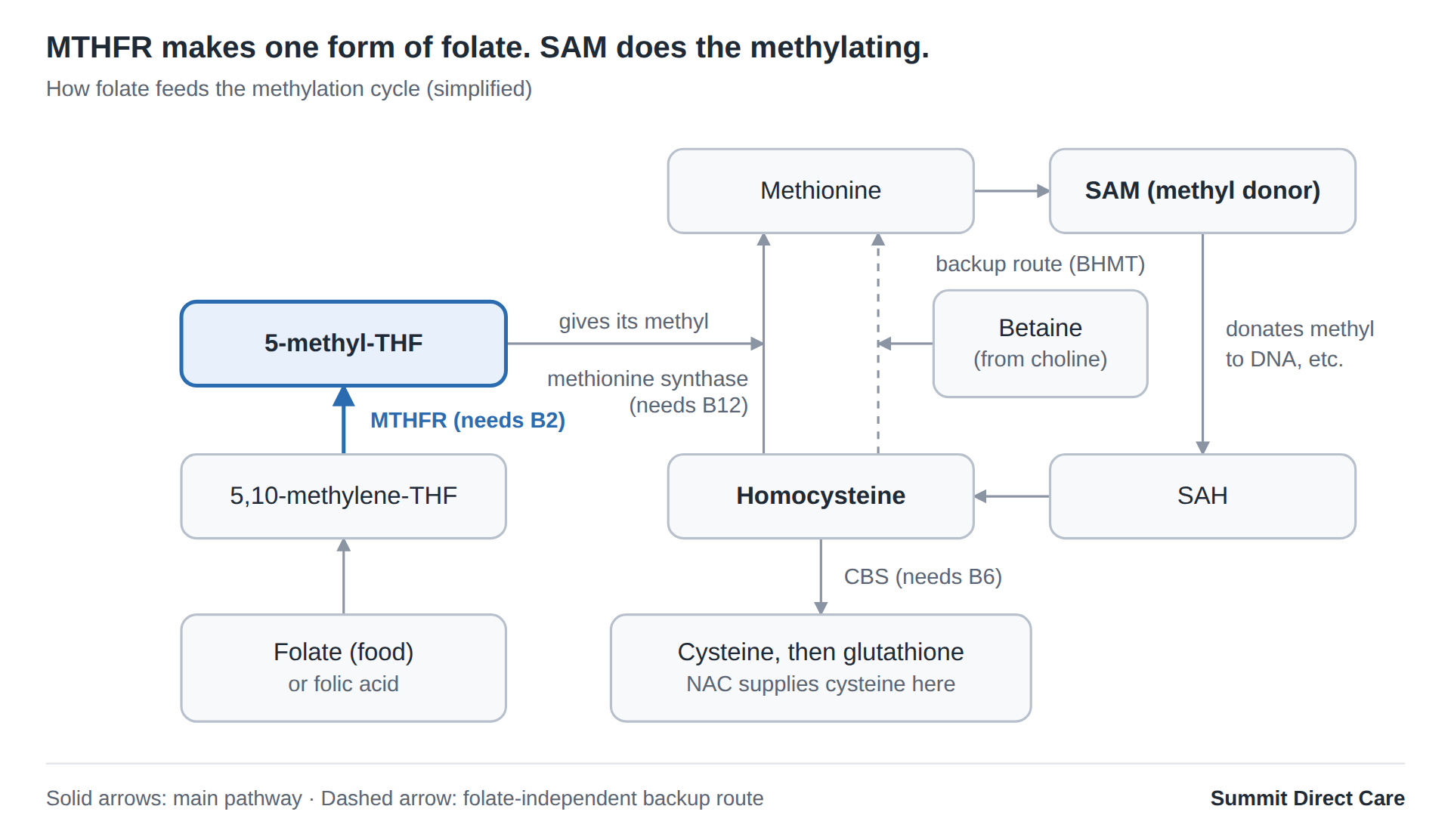
So why is MTHFR called a "methylation gene"? Because the methylfolate it makes feeds into a cycle that eventually produces your body's main methyl donor.
Methylfolate hands its methyl group to homocysteine. An enzyme called methionine synthase does this, and it needs vitamin B12. The result is methionine.
Methionine becomes SAM (S-adenosylmethionine). SAM is the molecule that does the methylating. It donates methyl groups for DNA methylation, neurotransmitter production, hormone processing and hundreds of other reactions.
After donating its methyl group, SAM becomes SAH, which becomes homocysteine again. Then the cycle repeats.
MTHFR is one supplier to this cycle, several steps removed from the methylation itself.
Your body has backup routes
Even when MTHFR runs slower, that doesn't translate into "poor methylation." Here's why:
A second recycling pathway. In the liver and kidneys, an enzyme called BHMT converts homocysteine back to methionine using betaine, which comes from dietary choline (eggs, meat, fish, beets, spinach). It doesn't need folate at all.
Methionine from food. Protein in your diet supplies methionine directly, which feeds straight into SAM.
The enzyme still works. Even the "strongest" common variant keeps about 30% of normal enzyme activity, and adequate folate helps stabilize it.
This is why research on people with MTHFR variants finds little or no difference in overall DNA methylation, except when folate intake is low.
How common are the variants, and what do they do?
The two variants people usually test for are C677T and A1298C.
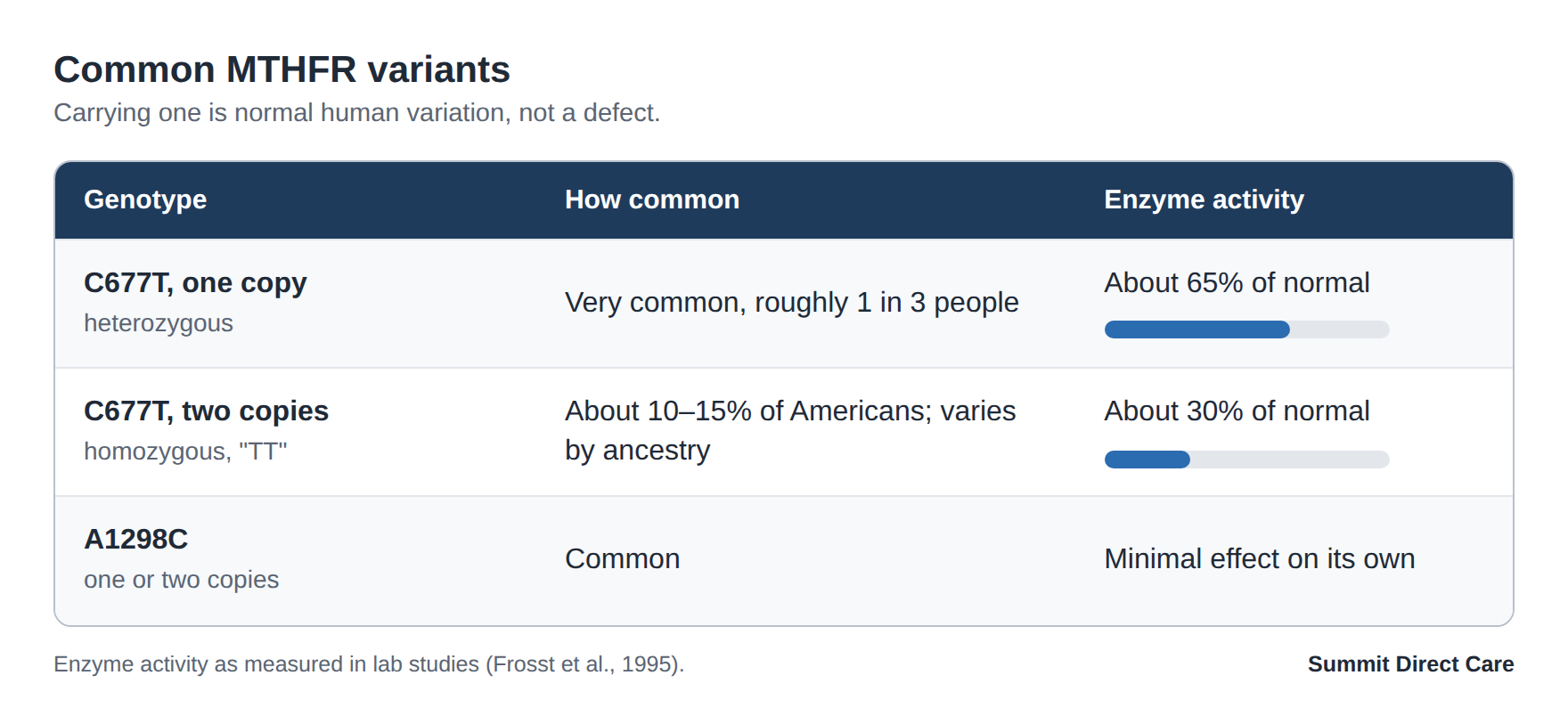
A gene variant carried by this many people is normal human variation, not a defect. Evolution doesn't keep something this common if it's broadly harmful.
What MTHFR variants don't do
They don't stop folic acid from working. This one gets its own section below.
They don't cause fatigue, brain fog or anxiety. Large studies haven't found a reliable link.
They aren't a reason to skip standard prenatal folic acid. The CDC recommends folic acid for all women who could become pregnant, regardless of MTHFR status.
They don't mean you "can't detox." That claim comes from a misunderstanding of what the enzyme does.
Why regular folic acid works fine
This is the claim we hear most often: people with an MTHFR variant supposedly can't "activate" folic acid, so they need methylfolate instead. It's repeated by a lot of sources people trust, so it deserves a full explanation.
The mechanism
Folic acid is activated by a different enzyme. Folic acid is a stable, synthetic form of folate. An enzyme called DHFR converts it to tetrahydrofolate (THF), the active form your cells use. MTHFR plays no role in this step.
Folic acid and food folate join the same pool. THF picks up a carbon unit, with help from vitamin B6, and becomes 5,10-methylene-THF. Folate from food ends up in exactly the same place.
Much of that folate never needs MTHFR. Cells use 5,10-methylene-THF directly to build DNA. That's the job that prevents neural tube defects. Only the portion headed for the homocysteine cycle goes through MTHFR.
The variant slows the last step. It doesn't block it. Even the TT form keeps about 30% of normal activity, and more folate available means more gets through.
Methylfolate doesn't "fix" anything folic acid can't. It simply enters the pathway one step later.
The evidence
A large double-blind trial in China gave folic acid to women of every MTHFR genotype. Blood folate rose and homocysteine fell in every group, including TT.
A meta-analysis of folic acid studies reached the same conclusion across genotypes.
U.S. grain fortification with folic acid began in 1998. Neural tube defects have since fallen about 35%, preventing roughly 1,300 affected births every year, in a population where 10–15% carry the TT genotype.
The stroke-prevention trial described below used ordinary folic acid.
A fair caveat. Human DHFR works slowly, so at high doses some folic acid circulates unconverted. No clear harm from this has been established, but it's one reason some people prefer methylfolate. Both are reasonable choices. What matters is getting enough folate, not which form it comes in.
When MTHFR actually matters: homocysteine
Here's the grain of truth. People with two copies of C677T (TT) tend to run higher homocysteine, particularly when folate, B12 or riboflavin (vitamin B2) is low. In our own practice we've seen substantially elevated homocysteine in some of these patients, and it's worth taking seriously.
Homocysteine is an amino acid that builds up when the recycling cycle above backs up. Elevated levels are associated with cardiovascular disease, stroke and blood clots. When homocysteine is high, SAH also accumulates, and SAH inhibits the enzymes that use SAM. So high homocysteine, not the gene itself, is the real way methylation can get compromised.
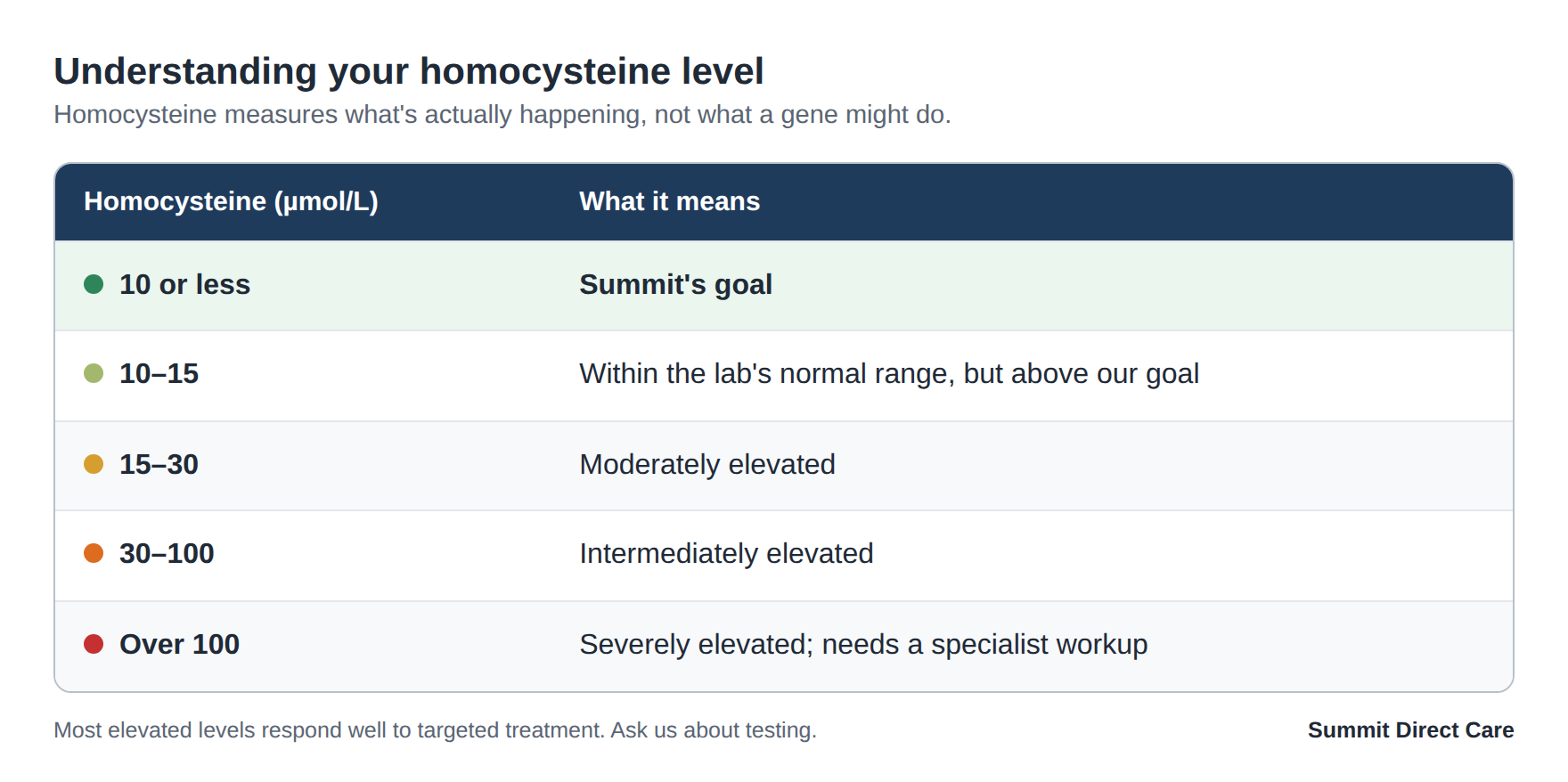
MTHFR is rarely the only cause. When we find high homocysteine, we look for:
B12 deficiency, which is common with metformin, acid-reducing medications, plant-based diets and age
Low folate, B6 or riboflavin intake
Reduced kidney function
Low thyroid function
Medications such as methotrexate, some anti-seizure drugs and levodopa
Smoking and heavy alcohol use
How we fix it
The good news: elevated homocysteine usually responds well to simple, targeted treatment.
Find and treat the underlying cause. That means checking B12 (and sometimes methylmalonic acid), folate, kidney and thyroid function, and reviewing medications.
Folate. Either folic acid or methylfolate lowers homocysteine. Methylfolate is a reasonable choice, but it isn't required.
Vitamin B12. Folate and B12 work as a pair. We always check B12 first, because high-dose folate can mask a B12 deficiency while nerve damage progresses.
Riboflavin (B2). MTHFR depends on a riboflavin-derived cofactor, and the TT form of the enzyme loses that cofactor easily. In clinical trials, low-dose riboflavin lowered homocysteine specifically in people with the TT genotype, and it also lowered blood pressure in TT patients with hypertension.
Vitamin B6 supports the other exit from the cycle, converting homocysteine into cysteine and then glutathione.
Betaine (TMG) can help in more stubborn or severe cases by boosting the backup pathway.
Recheck. We repeat homocysteine after about 8–12 weeks to confirm it's come down.
Does lowering homocysteine help? The evidence is mixed, and we'll be straight with you. Large trials of B vitamins in people who already had heart disease didn't reduce heart attacks. But a large trial in China, where folate intake was low, found that adding folic acid to blood pressure treatment reduced first strokes by about 21%. We treat elevated homocysteine because it's a marker of something off in your nutrition or metabolism, and correcting it is safe and inexpensive.
Should you get tested for MTHFR?
For most people, no. The result rarely changes what we'd do, and it often causes needless worry.
If we're concerned about how your body is handling folate and B vitamins, a homocysteine level tells us far more than the gene does. It measures what's actually happening. The gene only tells us what might happen.
The bottom line
MTHFR is a folate-processing enzyme, not a master methylation switch.
Having a common variant is normal and usually doesn't matter.
Folic acid works for everyone.
Homocysteine is what's worth measuring, and when it's high, it's very fixable.
Already been told you have an MTHFR variant, or curious whether a homocysteine check makes sense for you? Message us through the patient portal and we'll talk it through.
References
Frosst P, et al. A candidate genetic risk factor for vascular disease: a common mutation in methylenetetrahydrofolate reductase. Nature Genetics. 1995.
Friso S, et al. A common mutation in the MTHFR gene affects genomic DNA methylation through an interaction with folate status. PNAS. 2002.
Centers for Disease Control and Prevention. MTHFR gene variant and folic acid facts.
Crider KS, et al. MTHFR 677C→T genotype is associated with folate and homocysteine concentrations in a large, population-based, double-blind trial of folic acid supplementation. American Journal of Clinical Nutrition. 2011.
Colson NJ, et al. The impact of MTHFR 677 C/T genotypes on folate status markers: a meta-analysis of folic acid intervention studies. European Journal of Nutrition. 2017.
Williams J, et al. Updated estimates of neural tube defects prevented by mandatory folic acid fortification, United States, 1995–2011. MMWR. 2015.
McNulty H, et al. Riboflavin lowers homocysteine in individuals homozygous for the MTHFR 677C→T polymorphism. Circulation. 2006.
Wilson CP, et al. Blood pressure in treated hypertensive individuals with the MTHFR 677TT genotype is responsive to intervention with riboflavin. Hypertension. 2013.
Lonn E, et al. Homocysteine lowering with folic acid and B vitamins in vascular disease (HOPE-2). New England Journal of Medicine. 2006.
Huo Y, et al. Efficacy of folic acid therapy in primary prevention of stroke among adults with hypertension in China: the CSPPT randomized clinical trial. JAMA. 2015.