The symptoms that don't add up
Fatigue that doesn't improve with sleep. Skin that flares for no obvious reason. Brain fog on ordinary days. Bloating after meals. Hormones that seem off.
We hear these complaints constantly. They often get treated as separate problems by separate specialists. Sometimes they are separate. But sometimes there is a shared thread, and the gut is one of the places worth looking.
One idea that comes up often is "leaky gut," known in the research literature as increased intestinal permeability. It is a real, measurable phenomenon. It is also an area where the internet has gotten well ahead of the science. This article covers both: what's established, what's still being worked out, and how we approach it in practice.
What the gut lining actually is
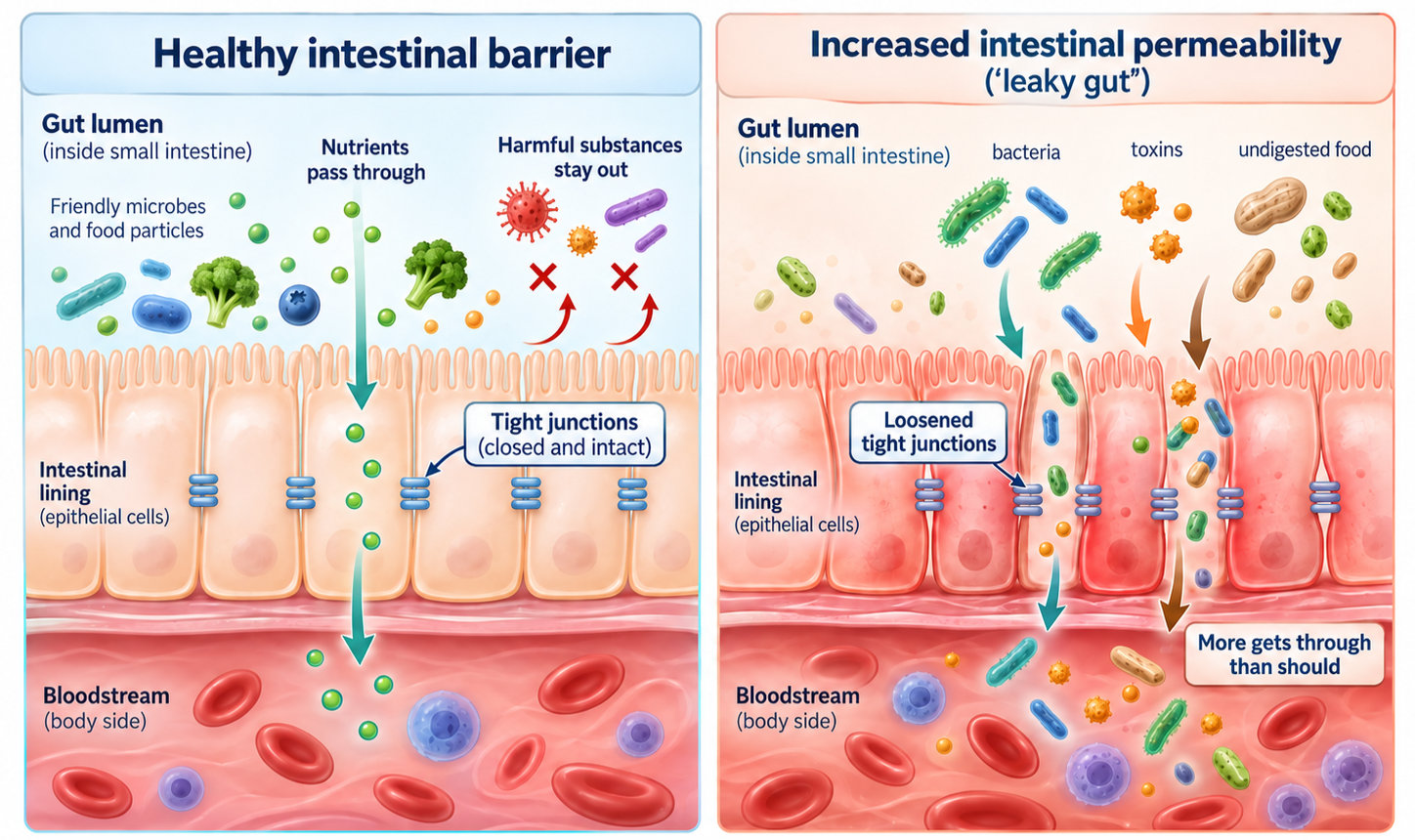
The small intestine is lined with a single layer of cells called the intestinal epithelium. Between those cells are protein complexes called tight junctions, which act like seals. Their job is to let nutrients through and keep bacteria, toxins, and undigested food particles out.
Above the cells sits a mucus layer, home to trillions of bacteria that make up the gut microbiome. Together, the cells, tight junctions, mucus, and microbiome form the main barrier between the outside world and the bloodstream.
Tight junctions are not permanently sealed. They open and close in response to signals from the gut environment. When that loosening becomes persistent, the barrier lets through more than it should.
What we know vs. what's still being studied
This is the part most leaky gut articles skip, and it matters.
Well established:
Intestinal permeability can be measured. The most common research method has a person drink two sugars of different sizes (lactulose and mannitol), then measures how much of each shows up in the urine. A healthy lining lets little of the larger sugar through. Permeability can also be measured directly in intestinal biopsy tissue. By these methods, it is increased in celiac disease, Crohn's disease, and ulcerative colitis. An important limitation: these are research tools. There is currently no validated, standardized test that a doctor can order to diagnose "leaky gut" in routine practice.
In Crohn's disease, increased permeability has been found in some people years before diagnosis.
Alcohol, NSAIDs (ibuprofen, naproxen), and severe physical stress reliably increase permeability.
Gliadin, a protein in wheat, triggers release of zonulin, a protein that loosens tight junctions. This effect is strongest in celiac disease.
Associated, but cause and effect unclear:
Increased permeability has been found alongside type 1 diabetes, rheumatoid arthritis, lupus, MS, Hashimoto's thyroiditis, eczema, depression, PCOS, and metabolic disease.
In most of these, we don't yet know whether the leaky barrier helps cause the disease, results from it, or both.
Still largely hypothesis:
That "leaky gut syndrome" is a single, distinct condition that explains fatigue, brain fog, hair loss, and hormone problems in otherwise healthy people.
We think the gut is worth taking seriously.
What breaks it down
Alcohol. One of the best-documented causes. Binge drinking (4 or more drinks in about 2 hours for women, 5 or more for men) and heavy drinking (more than 7 drinks a week for women, or more than 14 for men) increase permeability and alter the microbiome. A standard drink is 12 oz of beer, 5 oz of wine, or 1.5 oz of liquor, and a typical restaurant pour of wine is often closer to 1.5 drinks. The evidence below those levels is less clear.
NSAIDs. Over-the-counter pain relievers like ibuprofen and naproxen measurably increase small-intestinal permeability, even with short-term use. This is one of the most consistent findings in the field.
Chronic stress. The gut and brain communicate constantly. Human studies show acute psychological stress can increase permeability, likely through stress hormones that act on immune cells in the gut wall.
Microbiome disruption. Antibiotics change the microbiome, sometimes for months. An imbalanced microbiome produces fewer of the compounds that keep the lining healthy.
Wheat, in some people. In people with celiac disease, gluten drives intestinal damage and permeability. Many people without celiac disease also don't tolerate gluten, a recognized condition called non-celiac gluten sensitivity. In lab studies, gliadin also causes a transient increase in permeability in tissue from people without celiac disease. How much this matters for everyday health in non-celiac people is not settled.
Highly processed diets. Diets low in fiber starve the bacteria that produce butyrate, a short-chain fatty acid the gut lining depends on to maintain itself. Beyond fiber, specific additives are documented disruptors: emulsifiers like carrageenan, polysorbate-80, and carboxymethylcellulose degrade the mucus layer and loosen tight junctions — effects seen in both animal models and early human studies. Azo food dyes (Red 40, Yellow 5, Yellow 6) have emerging evidence of gut lining and microbiome disruption. Glyphosate, the herbicide used on most conventionally grown wheat and other grains, has been shown to interfere with tight junction proteins. Most people are exposed to several of these daily, over years. The cumulative load matters even when no single exposure seems dramatic.
What it might look like in the exam room
The patterns that make us consider the gut include:
Bloating, gas, irregular bowel habits, or food reactions
Persistent fatigue or brain fog without another explanation
Skin conditions like eczema or acne that haven't responded to standard care
An autoimmune diagnosis, especially with gut symptoms
Nutrient deficiencies (iron, B12, vitamin D, zinc) that keep coming back
None of these proves a leaky gut. Each has many possible causes. When several show up together, the gut is one of the places we look, alongside the other usual suspects.
How we evaluate it
The most important step is ruling out conditions that look like "leaky gut" but have specific, proven treatments.
Celiac disease. A blood test (tTG-IgA with total IgA). You need to be eating gluten for this test to be accurate. If you cut gluten first, the test can come back falsely normal. Get tested before changing your diet.
Inflammatory bowel disease. Fecal calprotectin is a well-validated stool marker for intestinal inflammation.
Nutrient deficiencies and other causes of fatigue. CBC, iron studies, B12, vitamin D, thyroid testing, and inflammatory markers as appropriate.
What about direct tests for permeability? The lactulose/mannitol test measures it directly and is the most established research method, but it isn't standardized for routine clinical use. Serum zonulin tests are widely marketed, but studies have shown the most common commercial version doesn't measure zonulin accurately. LPS antibody panels aren't validated either. We'll discuss these with you honestly, but we don't build treatment decisions around them.
How we address it
The gut lining is one of the fastest-regenerating tissues in the body. Small-intestine cells turn over every 3 to 5 days. When the irritants are removed, the lining has real capacity to recover.
1. Treat what we find. Celiac disease, IBD, infections, and deficiencies come first.
2. Remove the clear irritants. Reduce or stop alcohol. Minimize NSAIDs where possible, and talk with us before stopping any prescribed medication.
3. Feed the microbiome. We build the diet around fruits, vegetables, fermented foods, and quality meats. Diet should be individualized: some people do well with foods that others don't tolerate, so we tailor recommendations to you. Fermented foods like kefir, plain yogurt, sauerkraut, and kimchi increased microbiome diversity in a Stanford trial.
4. Consider an elimination trial. For some patients, a structured trial off gluten or dairy, with a planned reintroduction, helps identify a real trigger. We do this after celiac testing, not before.
5. Targeted supplements, where they fit. Some have early or modest evidence:
L-glutamine: improved permeability and symptoms in one well-designed trial in post-infectious IBS.
Zinc carnosine: prevented NSAID-induced permeability increases in a small study.
Vitamin D: worth correcting if you're deficient; it helps regulate tight junction proteins.
Specific probiotic strains: some barrier benefit in studies; results vary by strain and condition.
Supplements are not a substitute for the steps above.
6. Address the drivers. Stress, sleep, and ongoing medication exposures matter. Without them, progress tends to stall.
Timeline. Many patients who make these changes notice better digestion and energy within 4 to 8 weeks. More complex cases take longer. We track progress by symptoms and by whatever objective markers were abnormal at the start.
Why it's worth not waiting
Chronic inflammation, from any source, can cause damage that doesn't fully reverse. Once Hashimoto's has destroyed thyroid tissue, that tissue doesn't grow back. Erosive arthritis leaves permanent joint changes. Some forms of hair loss become permanent if left untreated for years.
We can't promise that treating the gut will prevent these outcomes; that hasn't been proven. What we can say is that persistent, unexplained symptoms deserve a real evaluation now, not years from now. Many of the causes we find are very treatable when caught early.
The bottom line
Intestinal permeability is real and measurable, and it plays a clear role in some diseases. Its role in others is plausible but still being studied. The steps that support a healthy gut barrier, such as less alcohol, fewer NSAIDs, more fruits and vegetables, fermented foods, and managing stress, are low-risk and good for you regardless.
At Summit, we take gut health seriously, and we try to be honest about what the evidence does and doesn't show. If you've been told your labs are normal but you don't feel normal, we'd like to take a closer look. Talk to us. Message your care team through the patient portal, and we'll sort through it with you and figure out the right next step.